Because that’s the range that’s been shown to trigger muscle growth. It’s a style of training where we aim to grow our muscles. We’re not talking about gaining strength or increasing endurance.
What are the Benefits of An Upper Lower Split Workout?
If you do the same weight for the same reps every week, growth stalls. Progressive overload is the principle of gradually increasing the demand on your muscles, and it’s non-negotiable for long-term gains. A vigorous workout can stimulate 2–4 days of muscle growth (study). That means you can keep your muscles growing all week long by training them every 2–4 days. In this article, we’re only talking about hypertrophy training.
As you get fitter, you can use shorter rest times. The fitter you are, the faster you can refuel your muscles. You won’t need to rest as long between sets. All of these workout routines can work equally well.
What Makes a Smith Machine Best for Muscle Building?
For example, on the pull workout day, you might do deadlift exercises. On the push workout day, the bench press is a good option. Leg day could involve squats or a similar exercise.

Signature Splits: Interval Guide to Cardio and Weight Training Classes
That’s where hypertrophy programs come in. We’re going to look at a detailed 4-week hypertrophy training program. Progressive overloading is the process of gradually increasing the acute variables (load, reps, or sets) to strengthen your skeletal muscles. Most of these risks can be avoided if you follow a structured program from a qualified trainer who knows your capabilities.
Pay attention to which exercises feel most natural and allow you to feel the target muscle working. Swap accessory exercises when progress stalls or to address weak points. Consume 0.7-1g protein per pound of bodyweight daily. Spread intake throughout the day for optimal synthesis.
This gives your muscles a chance to recover, but keeps the workout intense. Do you still need a power rack if you have a RitFit Smith machine? Not always, because many home gym users can cover most of their training with one Smith based station.
Programming: How to Use a RitFit Smith Machine for Muscle Growth
One study on strength development in athletes proved that doing multiple sessions per week is more effective than just one (3). The study involved two groups of participants. One group trained each muscle group two days per week, while the other trained just once per week. When doing an upper/lower split, you do one or two exercises per body part. Another option is to include compound movements. These are exercises that work two or more of these muscles at the same time.
Sets Per Week: The Volume Target
If you keep lifting the same weight for the same number of reps, growth stalls. Progressive overload is the principle of gradually increasing the demand on your muscles over time, and it’s the single most important training concept for long-term muscle gain. Time under tension (TUT) is the amount of time the muscle is under strain during an exercise. In hypertrophy training, the cells need to be under tension long enough for the muscle to get bigger—usually around 40–70 seconds. But you can also start with a shorter amount of time and increase the TUT over time to make your muscles even bigger, just like you would increase the weight or reps or sets. A repetition (rep) is one completed movement.
What kinds of training cause the most injury and why
Here is a straightforward program you can follow for two months. Perform this biceps workout 1-2 times per week, with at least two days of rest between sessions. To sum it up, the researchers found effective training needs both tension and stress. You should aim for multiple sets of 6 to 12 reps with short breaks.
Phase 2: Development (Weeks 5-
- Train each muscle group 2-3 times per week.
- ” and the trainer would yell, “give me 10!
- You also need to produce enough volume of tension over time.
- However, the upper body days are separated by pull and push exercises.
- Hypertrophy, however, is not driven by what happens in a single session.
- One thing to remember is that muscle size and muscle strength are connected but not necessarily the same thing.
Progressive overload forces the body to continually adapt, which is essential for building strength and lean muscle. At Basecamp Fitness, workouts are programmed to gradually challenge members so muscles continue adapting week after week. Part 6 is power — the quality most programs skip entirely. Power declines faster than strength or muscle mass as we age, and it’s the strongest predictor of functional capacity in older adults. We’re going to break down exactly how to train for it, what exercises to use, and how to add it to what you’re already doing without overhauling your entire program. When training for muscle growth, the goal is to direct and maintain tension in the target muscle throughout the movement.
What Are Strength Training and Hypertrophy Training?
Too much and you’re exceeding your recovery capacity. The sweet spot varies by individual, but research gives us clear guidelines. But progressive overload isn’t just about adding weight to the bar. If you finish a set thinking you could have done 2-3 more reps with perfect form, you probably could have done 4-5.
The calf was small, but so were Milo’s muscles, and so it was enough to is mad muscle legit challenge him. His muscles grew a little bit bigger every day, and so did the calf, ensuring that his muscles were always challenged. By the time the calf grew into a bull, Milo had become the strongest wrestler in Greece.
Warning Signs of Poor Recovery
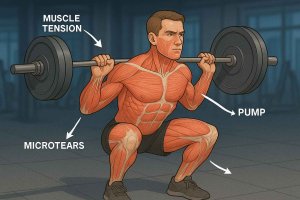
While that range is certainly effective, current research shows muscle hypertrophy occurs across a much wider spectrum than previously thought. To understand the science behind optimal rep ranges for hypertrophy, check out our detailed guide on rep ranges beyond the 8-12 rule. To simulate hypertrophy (build muscle) you first have to create a lot of mechanical tension in your muscle fibers. The best way to achieve this is lifting heavy weights. Most research shows that doing somewhere between 3–8 sets per muscle per workout is enough to stimulate a maximal amount of muscle growth. If you choose good exercises, lift through a deep range of motion, and strive to outlift yourself, each set can be quite powerful.